

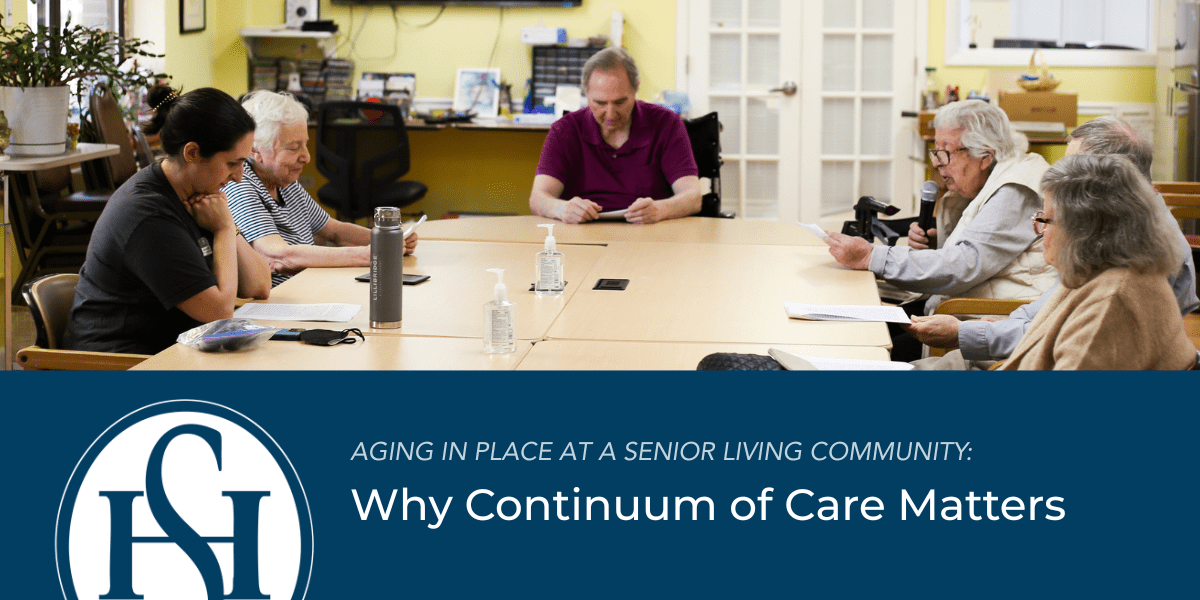
For many older adults and their families, the idea of “aging in place” is deeply comforting. It means staying rooted in familiar surroundings, maintaining routines, preserving independence, and continuing to feel at home as life changes.
But aging in place does not always have to mean remaining in the same private house forever.
In fact, for many seniors, a senior living community with a full continuum of care can offer a more supportive, secure, and sustainable version of aging in place. A version that allows residents to enjoy independence today while knowing additional care is available if and when it is needed.
At The Selfhelp Home, that continuum includes independent living, assisted living, skilled nursing care, and short-term rehabilitation. For residents and their families, this creates something invaluable: the ability to plan for the future without having to start over every time care needs change.
What Is a Continuum of Care?
A continuum of care refers to a range of living options and healthcare services designed to support older adults through different stages of aging. Instead of treating each level of care as a separate decision, a continuum allows residents to move between different types of support within one trusted community.
For one resident, that may begin with independent living: enjoying a private apartment, social opportunities, meals, activities, and the ease of maintenance-free living.
Over time, if daily needs change, assisted living services may provide help with medication management, dressing, bathing, mobility, or other activities of daily living.
For another resident, skilled nursing care may become necessary due to more complex medical needs. And for someone recovering from surgery, illness, injury, or hospitalization, short-term rehabilitation can provide the therapy and support needed to regain strength and confidence.
The beauty of a continuum of care is that it is designed around the reality of aging: needs can change.
Sometimes those changes happen gradually.
Sometimes they happen unexpectedly.
In either case, having care options already in place can make the journey feel less overwhelming.
Aging in Place With Support Already Around You
When families think about aging in place at home, the conversation often turns to modifications and planning: grab bars in the bathroom, safer flooring, stair access, transportation, home care, emergency response systems, and support with meals or medication.
Those are important considerations. But even with the best planning, aging at home can become complicated when care needs increase. Families may find themselves coordinating multiple providers, arranging transportation to appointments, managing medication changes, or trying to determine when extra help is needed.
A senior living community with a continuum of care helps ease that burden.
Residents are already surrounded by people who know them. Staff members become familiar faces. Routines are established. Relationships are formed. When additional support is needed, it can often be introduced with greater continuity, sensitivity, and understanding.
That means you don’t have to wonder where to turn next. Feel assured knowing there is a thoughtful structure in place, built for support today and adaptable for the future.
Independence Today, Peace of Mind for Tomorrow
One of the most common misconceptions about senior living is that moving into a community means giving up independence. But in reality, the right community can help protect independence by removing many of the daily stressors that can make aging more difficult.
Independent living allows residents to enjoy the privacy of their own space while gaining access to the comforts of community life.
There is less to manage, fewer household responsibilities, and more opportunity to focus on the things that bring joy: friendships, activities, shared meals, cultural programs, fitness, hobbies, and time with family.
At the same time, the continuum of care offers peace of mind.
Residents do not have to wait for a crisis to think about the next step. Families do not have to make rushed decisions during an already stressful moment. Instead, there is a plan and a trusted place where that plan can unfold with care.
That sense of stability is one of the greatest benefits of choosing a community like The Selfhelp Home. It allows residents to settle in, build relationships, and truly feel at home, knowing that support can grow with them.
Smoother Transitions When Needs Change
Change is never easy, especially when it involves health, independence, or a loved one’s care. But transitions can be gentler when they happen within a familiar community.
A resident who begins in independent living may later benefit from assisted living services without losing the comfort of the place they already know. Someone who needs skilled nursing care may still be surrounded by the rhythms, staff, and community atmosphere that have become familiar. A resident returning from the hospital may receive short-term rehabilitation in a setting connected to their broader care journey.
This continuity can make an emotional difference. Instead of feeling like each new level of care is a disruption, residents and families can experience it as part of a thoughtful path forward.
A Community That Becomes Home
Aging in place is about more than where someone lives. It is about belonging, feeling safe, seen, and supported. It is about continuing to live with dignity and purpose.
That is what makes the community aspect of senior living matter so much.
Meals shared with neighbors, conversations in common spaces, regular programming, familiar caregivers, and daily moments of connection all contribute to a sense of home. Over time, a senior living community can become a place filled with routine, friendship, comfort, and trust.
Planning Ahead Is an Act of Care
Choosing a senior living community is a meaningful decision. For many families, it begins with a question: What does my loved one need right now? But an equally important question is: What might they need in the future?
A full continuum of care helps answer both.
It gives residents the opportunity to enjoy the present while preparing for what may come next. It gives families confidence that their loved one will not have to navigate future changes alone. And it creates a path for aging in place that is rooted in stability, familiarity, and peace of mind.
To learn more about life at The Selfhelp Home and the full continuum of care available to residents, schedule a tour today.
