

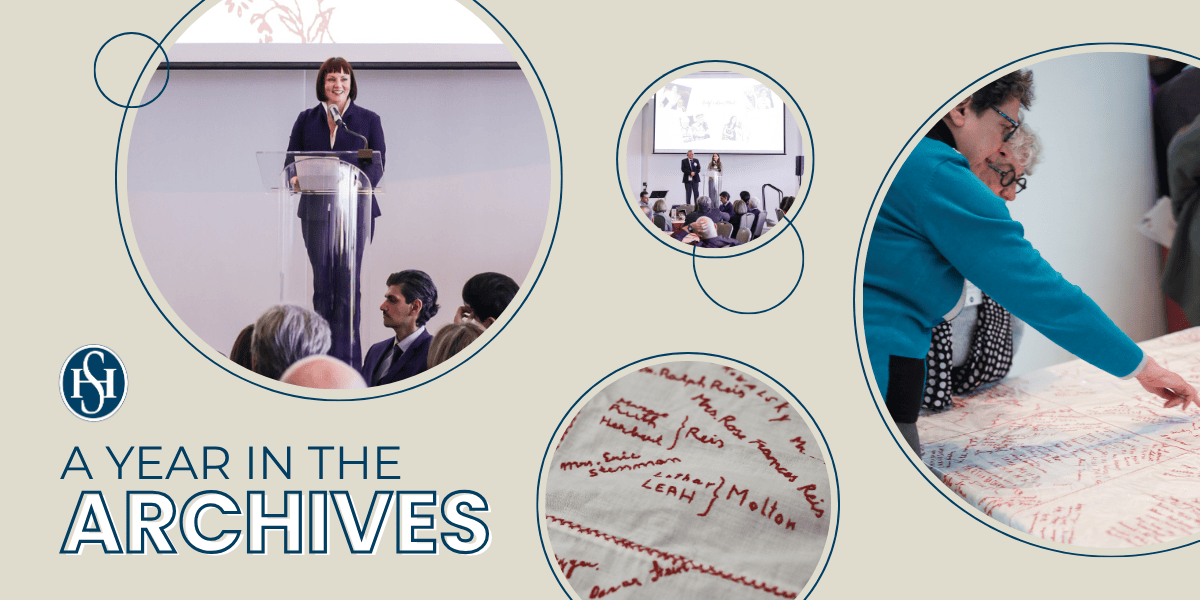
For the past year, Mandy DeLeon has been following a trail of stories.
Some were tucked inside letters. Others were preserved in scrapbooks, diaries, recipe cards and hand-stitched tablecloths. Some lived in family memories, waiting to be rediscovered.
Together, they have begun to reveal the living story of The Selfhelp Home.
A historian whose work centers on archival object and provenance research, Mandy has spent the last year tracing Selfhelp’s institutional memory, material culture and community rituals. This research is helping to shape the permanent Historical Installation currently under construction at Selfhelp.
This installation is designed to preserve our history, and help residents, families, staff, donors, students and visitors feel the heart of the story.
For Mandy, the work lives in a delicate and meaningful balance.
“This exhibit is held in the tension between an institutional and an intimate home exhibit,” she shared. The goal is to tell the full history of Selfhelp without losing what makes that history so personal: the family rituals, shared meals, new traditions and “sense of homecoming” that have shaped the Home for generations.
That intimacy is built into the archive itself.
This is not a traditional collection gathered neatly in one place. It is, in many ways, a grassroots archive, one shaped by women, families, volunteers and community members who documented Selfhelp’s story through everyday objects and personal records.
Exhibit content developer Karen Herman described the process simply: “Mandy really had to be a detective.”
The Selfhelp story wasn’t waiting for her in a single file cabinet. It was uncovered piece by piece, through digitized archives, private family collections, Selfhelp’s file cabinets, and the memories of descendants. Materials continue to emerge, making the project a living, breathing, growing story.
Through that research, stories have been uncovered that even families had never heard. One discovery led to a letter from Henry Morgenthau describing the arrival of Aufrechts at Ellis Island — and the remarkable image of refugees stepping off a boat and into a limousine to their wedding.
Another connected a great-grandson with letters between co-founder Walter Friedlander and his great-grandmother, opening a door to a family story that had nearly been lost.
For Mandy, these moments are among the most meaningful aspects of the work. “Those ‘Eureka!’ moments aren’t me discovering this wonderful thing,” she said. “It’s me getting to watch someone connect with their past.”
“Those ‘Eureka!’ moments aren’t me discovering this wonderful thing, it’s me getting to watch someone connect with their past.”
That connection became especially clear during a recent Zoom gathering with cousins whose family donated the Heilbrunn Torah in the 1960s. Reuniting after decades, they reconnected with each other, remembered parents and grandparents, and returned to a shared family story.
The project itself became an act of homecoming.
Homecoming has become the through-line of the installation. It is there in Selfhelp’s founding as a mutual aid organization. It is there in the politically experienced activists, socialists and
feminists from Europe who rebuilt their organizing work in Chicago after immigration. It is there in the survivors and refugees who found not only services, but community, comfort and a place to belong in their later years.
Karen explained that every exhibition needs a through-line, something that carries visitors from the beginning of the story to where it stands today. For Selfhelp, Mandy found that through-line in homecoming and community. The Sunday concerts, shared meals and rituals still carried forward are not simply programs or traditions. They are evidence of what Mandy called the “communal memory” at the heart of Selfhelp.
The Historical Installation will offer a different kind of Holocaust remembrance — one that does not end the story in 1945. Instead, it asks what happened after.
How did people rebuild? How did they create rituals, friendships, families and traditions? How did they make a home?
Over the course of a year, Mandy has helped bring those answers forward. And as the installation continues to take shape, Selfhelp’s archive continues to grow.
This is the story Selfhelp is preparing to share. A story of survival, yes, but also of return. Of community. Of generations gathered around the same table. Of a home that continues to welcome people back.
